



2026 has been a year of growing momentum for educators who want something better than the union model despite the constant stream of effort coming from the American Federation of Teachers (AFT) and the National Education Association (NEA) to convince them otherwise.
The evidence arrived in Dallas, where hundreds of educators from across the country gathered for the fourth annual Teacher Freedom Summit.
Held July 14-16 at the Sheraton Dallas Hotel, this year’s summit offered 65 sessions and as many as 19 hours of professional development.
Educators, administrators, school board members, and education advocates came together with a shared interest in improving public education while breaking the grip of the teachers’ union have maintained over public education.
The Freedom Foundation launched the Teacher Freedom Alliance in March 2025 to provide educators with a genuine alternative to union membership. TFA offers teachers free professional liability insurance, professional development, alternative curriculum, and a national community of educators without forcing them to subsidize the agendas of the NEA and AFT.
This year’s summit showed how popular this alternative movement has grown.

Freedom Foundation CEO Aaron Withe
The event got under way on July 14, as attendees arrived for registration and filled the conference hall. TFA CEO Ryan Walters opened the program by welcoming educators and outlining the organization’s mission. Author James Lindsay followed with a presentation on Critical America Theory, which is meant to address the ideology of we know commonly as “woke” that has increasingly worked its way into American classrooms.
Ken Pope, a senior fellow at the Victims of Communism Memorial Foundation, discussed the experiences of victims of communism, while Ashley Cash, president and manager of CCC Capital Solutions, Inc., discussed teaching financial literacy and practical skills.
Together, the opening sessions established the summit’s principle: Teachers should be equipped to educate students, defend their judgment and prepare young people for life rather than serve as organizers for the NEA and AFT establishment.
That afternoon included a state networking reception, giving educators the opportunity to meet teachers and advocates working in their own communities.
That was followed by the opening dinner, during which Freedom Foundation CEO Aaron Withe introduced attendees to TFA and provided an assessment of the state of American education.
U.S. Secretary of Education Linda McMahon then joined the summit for a special fireside discussion. McMahon discussed the federal government’s role in education and the importance of returning authority to states and communities.
The night concluded with a special screening of the film “Reagan.”

U.S. Secretary of Education Linda McMahon and Deputy Chief of Staff for Policy and Programs Lindsey Burke
Wednesday, July 15, was the summit’s busiest day of programming. The morning began with a presentation on classroom behavior strategies, followed by Freedom Foundation Research and Government Affairs Director Maxford Nelsen’s discussion of teachers’ First Amendment rights and union dues.
The 2018 U.S. Supreme Court decision in Janus v. AFSCME affirmed that public employees cannot be forced to pay a government union as a condition of employment. Yet many educators still do not fully understand their right to reign from union membership, stop paying dues, and seek professional support elsewhere.
Nelsen gave attendees the information unions have little interest in providing.
From there, educators moved between an extensive selection of breakout sessions. These examined the science of learning, social and emotional learning, artificial intelligence, relationships between school boards and classrooms, teacher mobilization and competition in education.
During lunch, author and education policy expert Daniel Buck addressed attendees from the main stage, emphasizing the importance of teaching truth and not lies.
The range of subjects made in contract with the NEA and AFT conventions show how much more freedom and true diversity TFA provides. Teachers were not being instructed on what to think, what to like, who to support.
Rather, they were learning about how to think, how to teach others how to think, how to manage their classroom, understanding their rights, improving their schools, and techniques to organize independently free from the whims of the NEA and AFT.
Wednesday evening began with Texas Education Commissioner Mike Morath discussing the work required to improve literacy. Erica Donalds, CEO of OptimaEd and chair of education opportunity at the America First Policy Institute, then delivered the evening keynote address.
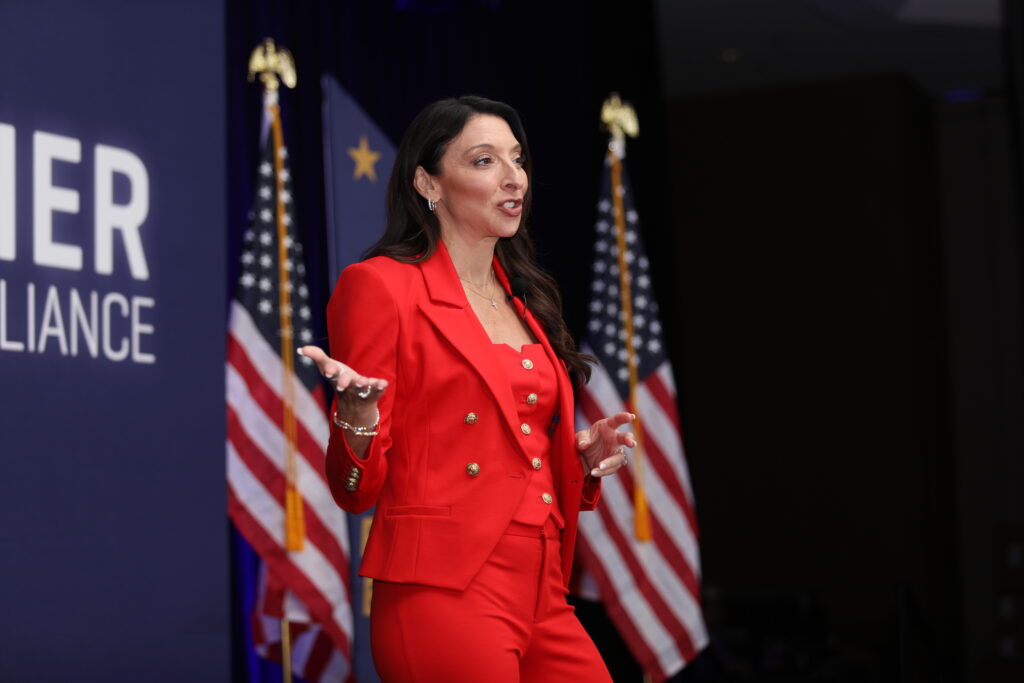
Speaker Erika Donalds
The night concluded with the summit’s Teacher of the Year celebration. Stacy Adair, the organization’s Teacher of the Year in 2025, presented Katie Hofsess with the 2026 award and a $10,000 check.
Country music singer Coffey Anderson also performed for summit attendees, helping close out an exciting day of professional development, networking and recognition for educators willing to stand up for their profession.
2026 Teacher of the Year, Katie Hofsess

The conference resumed Thursday morning with presentations from Lenny McAlllister, Nick Hahn and school choice advocate Corey DeAngelis.
The final group of breakout sessions covered subjects including healthier lives for educators, constitutional education and financial freedom for teachers. One session examined whether the “Whole Child” and community-school models genuinely support students or gradually transfer reasonability and authority away from families.
In general, the sessions focused on the political implications of everyday classroom interactions.
The closing mainstage program continued with Frank Murphy discussion sports choice, Dr. Leonard Sax examining the emerging science of sex differences and Delia McCabe addressing teacher burnout and recovery.
During the summit, educators also signed a Declaration of Independence from Teachers Unions, giving symbolic form to the choice thousands of teachers are making.
Walters concluded the conference with a final call to action. The NEA and AFT have spent decades telling educators that union membership is the price for professional support. They collect teachers’ money and use the resulting power to pursue political objectives that frequently have little to do with classroom instruction or student achievement.
The Teacher Freedom Alliance begins on a different note. Teachers should be free to obtain protection, improve their skills, build relationships and advocate for their students without surrendering their paychecks to an oppressive rent-seeking machine.
When these educators return to their school this fall, they will do so with practical classroom tools, a national network of allies and a clearer understanding of their rights.
The scale of this year’s summit alone shows that educators are no longer waiting for the NEA or AFT to reform themselves. They have already started to build the alternative without them.