

While canvassing outside UCLA’s Reagan Medical Center this week, the Freedom Foundation’s Elite Canvassing Team witnessed a moment that revealed exactly why so many public employees quietly say they feel pressured inside their own workplaces.
Our presence at UCLA isn’t random. We’re here for a very specific reason — to inform Teamsters 2010 members about their opt-out window, a narrow opportunity that only opens once every three years.
If members don’t request to end their union membership and dues deductions during that window, they’re locked for another full three-year cycle.
Many employees we’ve spoken with had absolutely no idea that restriction even existed — just as their union intended.
That’s why the conversations matter.
While my fellow members Dustin James, Butch Cassidy and Caleb Stokes were busy engaging workers across campus, I was speaking with four healthcare employees represented by AFSCME 3299.
The conversation was calm and respectful. They were surprised to learn that union dues are voluntary and opting out is a constitutional right.
As I walked them through how the process works, they asked thoughtful questions and took brochures — not just for themselves, but extra copies for coworkers.
That’s when an AFSCME representative inserted herself into the conversation.
“He’s spreading misinformation,” she told the workers. “You’re not allowed to opt out.”
The claim was not only false; it was revealing. These were licensed healthcare professionals being told they were not allowed to stop financially supporting a private organization.
The statement itself perfectly illustrated the kind of pressure employees often describe to us quietly.
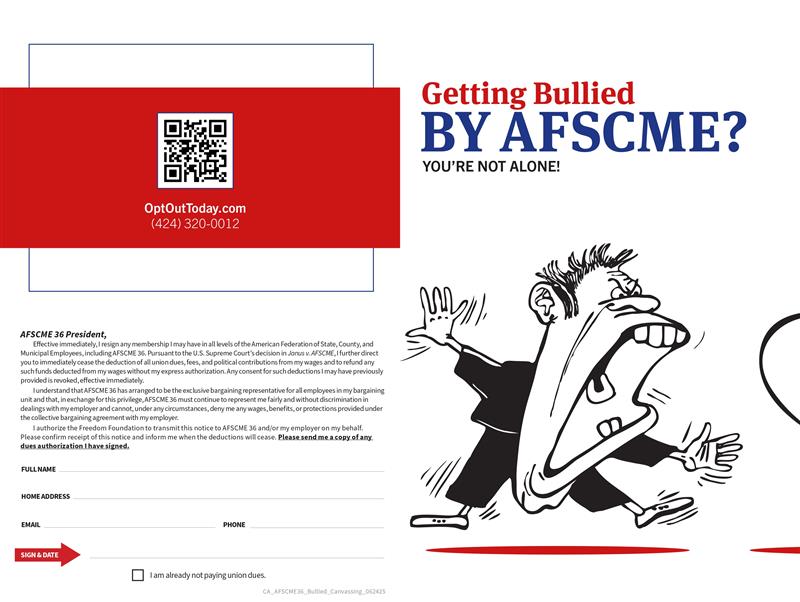
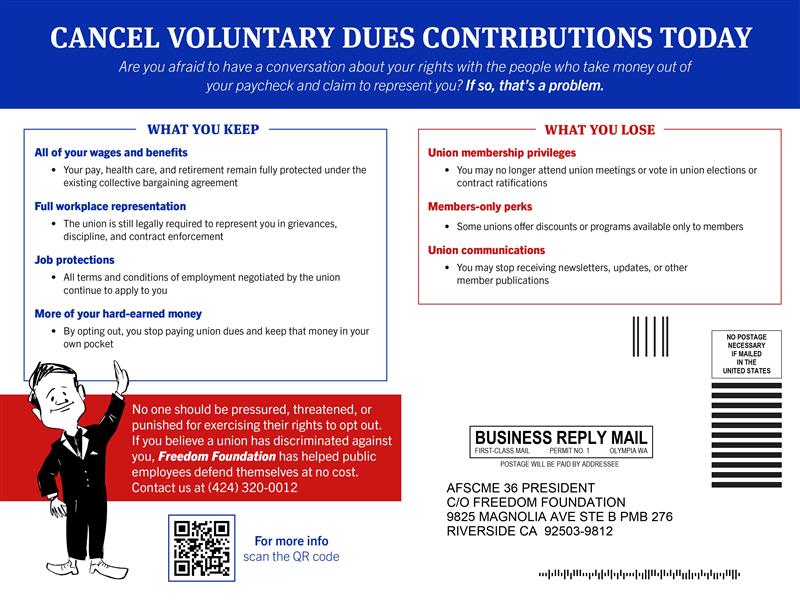
What made the moment even more striking was what the women were holding in their hands. The brochure Dustin designed reads clearly across the front:
“Getting Bullied By AFSCME? You’re Not Alone!”
Without escalating the situation, I pointed to the headline and calmly said, “This is exactly what we’re talking about.”
The timing could not have been more fitting. The representative grew visibly frustrated and pivoted, claiming I didn’t have the right to speak with employees.
That was just as inaccurate as her earlier statement. But by then, she had already proved my point.
Importantly, the four women didn’t walk away. They didn’t return the materials. They didn’t side with the union official attempting to shut down the conversation.
They stayed engaged, continued asking questions and left with additional literature.
Meanwhile, elsewhere on campus, our conversations with Teamsters 2010 members were some of the most eye-opening of the day. We spoke with dozens, and not one expressed satisfaction with their representation.
Many were unaware their opt-out opportunity only comes once every three years. Several reacted with frustration upon learning that if they miss the window, they’re stuck paying dues for another full cycle.
Every Teamster member we spoke with took opt-out information. Many requested extras for friends and coworkers.
Some thanked us directly — with handshakes and fist bumps — for explaining something they felt had never been clearly communicated to them.
That contrast is important.
On one hand, union representatives attempt to shut down conversations by claiming employees are not allowed to exercise their rights. On the other, workers quietly express appreciation when someone simply explains what those rights are.
Throughout the day, the Freedom Foundation’s Elite Canvassing Team distributed straightforward, rights-based materials focused on workplace freedoms and employee choice.
The response was clear and consistent. Workers want clarity. They want transparency.
What they do not want is to be told what the union thinks they’re allowed to do.
When a union representative feels compelled to interrupt a peaceful conversation and misstate the law in order to maintain control, that doesn’t signal strength.
It signals insecurity. Organizations confident in their support do not need to rely on intimidation. They allow workers to make informed, voluntary decisions.
If you are a public-sector employee and want to learn more about your rights, you can get clear information about how the process works and opt out of paying union dues by visiting optouttoday.com.
The choice to financially support a public sector union is optional — and it’s all yours..
(Editor’s note: Dustin James, Butch Cassidy and Caleb Stokes contributed to this blog.)